
Businesses accumulate assets, not activity
Businesses accumulate assets, not activity
The word you use for marketing determines what you can do with it.
Sit in enough budget meetings, and you notice that marketing almost always arrives as a list of things to do. A campaign in March. A trade show in May. A new website, some sales collateral, a sponsorship that has been renewed for so long nobody remembers why. Finance looks at the list and sees costs, because that is what a list of activities is. Each item has a start date, an end date and an invoice.
Then something predictable happens. Money gets tight, a few items come off the list, and nothing visibly changes the following month. Sales hold. The phone still rings. To everyone in the room, that looks like proof the activity did little, and the next round of cuts is easier than the first.
The problem in that meeting isn’t the finance team, and it isn’t the marketing team either. It is the vocabulary. If everything is described as activity, then stopping it looks free. The cost of stopping only appears later, after you've lost the connection between cause and effect.
What makes something an asset
An asset, in the plain sense I mean it, is something that keeps working for you after the activity that created it has stopped.
An advertisement runs for three weeks and disappears. The memory it leaves in a few hundred thousand heads can last for years. A salesperson has one good conversation with a buyer and moves on. The trust that conversation built stays with the account long after the salesperson has left the company. A customer has a problem sorted quickly and properly on a Friday afternoon and tells three people about it over the weekend. None of that shows up on a balance sheet, and all of it makes next year’s demand cheaper to create.
Once you think of these things as assets, a different set of questions becomes available. An asset can be invested in, so you can ask what you are putting in. You can measure it, so you can ask what state it is in. It can appreciate, so you can ask whether it is growing. It can be neglected and spent, so you can ask whether this year’s results were paid for out of capital that earlier investment built. None of those questions makes sense about a list of activities.
The five
Five assets determine how easy or hard it is for a business to create demand. I want to introduce them properly, because the one-line versions are too easy to nod along to.
Value is the customer’s judgement that choosing you is worth what they have to give up. That includes money, but also time, effort, risk, and the awkwardness of changing suppliers. Value comes from the product, the proposition, and how you structure and explain the price. You most often spend it through discounting, which teaches customers what you are really worth.
Memory is whether you come to mind at all when someone is choosing. Most buying starts with a short list somebody didn’t know they were making, and a business not on it never gets a hearing. Jenni Romaniuk’s work on category entry points is the best guide I know to how this works: people do not think of brands in the abstract; they think of them in situations. Memory is built slowly, by reaching people consistently with things they can recognise as yours. You lose it by going quiet, and even faster by changing everything every eighteen months.
Preference is whether the balance of choice leans your way once the alternatives are in front of someone. It is rarely a deep attachment. More often, it is a small tilt, built on familiarity, reassurance, and one or two reasons that seem good enough. It is built by giving people something to lean towards. It weakens, usually without anyone noticing, when competitors improve, and you don't.
Access is whether a person who has decided to act can do so without unnecessary effort. Stock on the shelf, a website that works on a phone, a quote that arrives this week rather than next month, a phone that somebody answers. It is the least glamorous of the five and the one where demand you have already paid for most often leaks away.
Experience is the evidence that tells people whether choosing you was a decision worth repeating. It is also what they pass on. Experience is built by delivering what was promised, and occasionally a little more. It is spent quietly, by cost programmes, growth and the ordinary tiredness of doing the same thing for a long time.
Buying an outcome and building something
None of this argues against activity that produces results this month. Paid search, promotions, and sales incentives all have a place, and a business that refuses to use them is making a different mistake. Les Binet and Peter Field spent years showing that the long effects of brand building and the short effects of activation are different things that work on different timescales, and that most businesses need both.
The distinction worth holding onto is this. Some spending buys an outcome. When you stop paying, the outcome stops. Other spending builds something, and what it builds keeps paying after the spending ends. Both are legitimate. The trouble starts when a business can only see the first kind, because then every cut to the second kind looks costless and every increase in the first looks like efficiency.
Ask most leadership teams what outcomes they bought last quarter, and they will tell you in some detail. Ask them what they built, and what state each of those five things is in compared with a year ago, and the room tends to go quiet.
What changes when you use the word
Three things change, in my experience, once a leadership team starts talking about assets rather than activity.
The budget conversation changes first. Instead of arguing about whether a campaign worked, people start asking what it was supposed to build and whether it’s stronger than it was. That is a harder, far more useful question, and it puts marketing and finance on the same side of the table, because accountants understand assets better than anyone.
The handover changes next. When a new chief executive or marketing director arrives, they inherit a set of assets in a particular condition, not a campaign calendar. That makes it much harder to throw away something that is working simply because it was somebody else’s idea.
And harvesting becomes visible. A business that is spending its memory, or living off a reputation built by people who have since left, can see it. It may decide to carry on. Sometimes harvesting is the right call. But it becomes a decision someone made, rather than something that happened while everyone was watching the sales line.
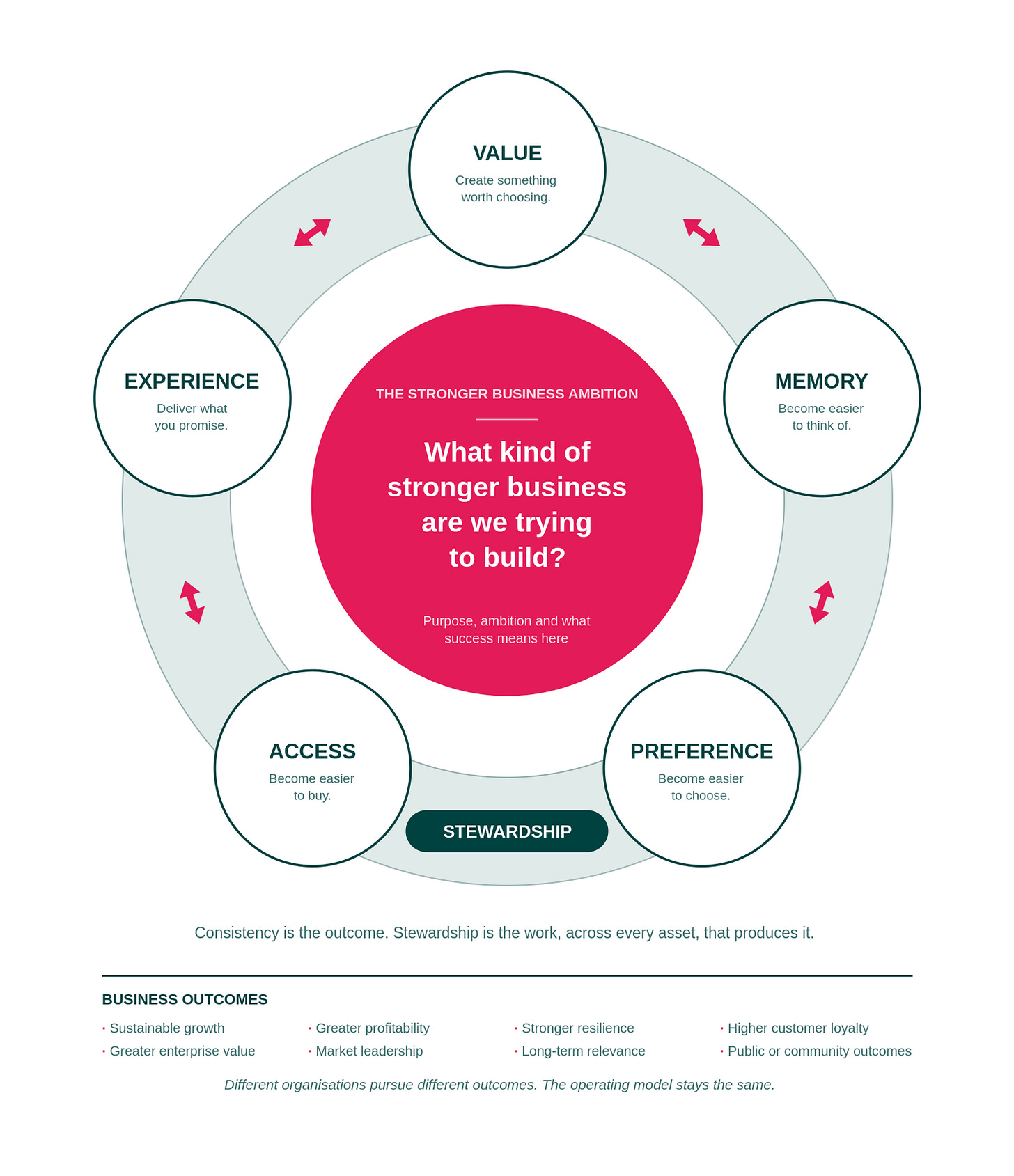
That is the idea at the centre of the Stronger Business Operating Model, which I have written up in full here: https://somethingdifferent.co.nz/musings/the-stronger-business-operating-model.html. The five assets sit in the middle of it, and everything else in the model is about how you look after them.
Here is the question to take away. If you stopped all marketing activity tomorrow, which of your five would still be working for you a year from now, and which would be gone by Christmas?