Consistency is the outcome. Stewardship is the work
Nothing erodes because somebody decides it should. That is exactly the problem.
Nobody sets out to weaken a business. I have never been in a meeting where someone proposed making the product less worth buying, the brand harder to recognise, or customers less likely to come back. Yet all three happen all the time in well-run companies.
They happen as side effects. A decision gets made for a perfectly good reason, and it has a consequence nobody was watching for. Then another decision, and another. None of them is a mistake on its own. Added together, they take something the business spent years building and quietly spend it.
That is why erosion is so hard to stop. There is no decision to reverse, because nobody made one.
How each asset wears away
Each of the five assets erodes in its own way, and it is worth being specific, because the general version is too easy to agree with.
Value drifts. What customers want moves slowly, and a proposition that was exactly right five years ago becomes slightly less right every year without anything changing. The business did not get worse. The world moved, and it stayed in place.
Memory fades, and it fades faster through inconsistency than through silence. A business that goes quiet for a year loses some ground. A business that changes its look, its line and its tone of voice every time a new marketing lead arrives loses more, because it keeps asking people to learn it again. People inside a business tire of their own brand long before customers have properly noticed it, which is why so much recognition gets thrown away out of boredom.
Preference weakens when competitors improve. Nothing you did changed; they simply got better, and the small tilt that used to favour you now favours them.
Access deteriorates as buying behaviour shifts around a business that hasn’t changed with it. The way people found and bought things ten years ago is not how they do it now, and a business that was easy to buy from then can be hard to buy from now.
Experience declines as organisations grow, cut costs, or simply lose interest. The founder who used to personally call unhappy customers stops doing it. A service team is restructured. A step is automated. Each change saves something measurable and removes something that was not being measured.
Why wanting consistency is not enough
Everybody agrees that consistency matters. It is in the brand guidelines. It comes up at every offsite. And it keeps not happening, because consistency is an outcome, and you cannot instruct an outcome. You can only do the work that produces it.
Brand guidelines are a good example of the gap. They protect the logo, the colours and the typeface, which is worth doing. But most say very little about the proposition, price architecture, service standards, or the buying process, where most erosion happens. A business can follow its guidelines perfectly and still be spending every one of its five assets.
I call the work that produces consistency stewardship, and it is a job. It has three parts. Protecting what is creating value. Strengthening what is weak. And changing what must change without needlessly destroying what has already been built. The third part is the hardest because it requires telling the difference between something that works and something that is merely familiar to the people inside the business.
The reset tax
Where stewardship is missing, businesses pay what I call a reset tax. New leadership arrives and reopens questions that were settled for good reasons nobody wrote down. A rebrand discards years of recognition because the incoming team wants to make its mark. A cost programme removes the one thing customers valued most because it didn’t show up in the analysis.
None of it is irrational at the time. Each decision has a sponsor and a business case. But each one means starting over, and a business that starts over every three or four years never gets the compounding that makes a strong business strong. It keeps paying to rebuild advantages it already had.
Where stewardship is present, the opposite happens. Each cycle of work starts from a stronger base than the one before. That is the only way I know for the five assets to compound rather than reset.
What it looks like in practice
Stewardship does not need a department. It needs three things, and most businesses have none of them.
It needs a leadership-level person who knows it is their job. Not a guardian of the logo, but someone explicitly responsible for asking, for any significant decision, what it will do to the five assets. Often that is the chief executive. Sometimes it is the marketing lead. What matters is naming the responsibility, because a responsibility that belongs to everyone belongs to no one.
It needs a record of what has been decided and why. New people inherit outputs; they rarely inherit reasoning. If the reasons a proposition, a price or a look were chosen are written down, the next leadership team can change them deliberately rather than accidentally.
And it needs a short set of measures that are watched over years rather than quarters. Not many. Enough to tell you whether each asset is getting stronger or weaker, so that erosion shows up as a trend before it shows up in the results.
That is why stewardship sits in the ring around the diagram rather than alongside the five. It is not a sixth asset. It is the work that happens across all of them.
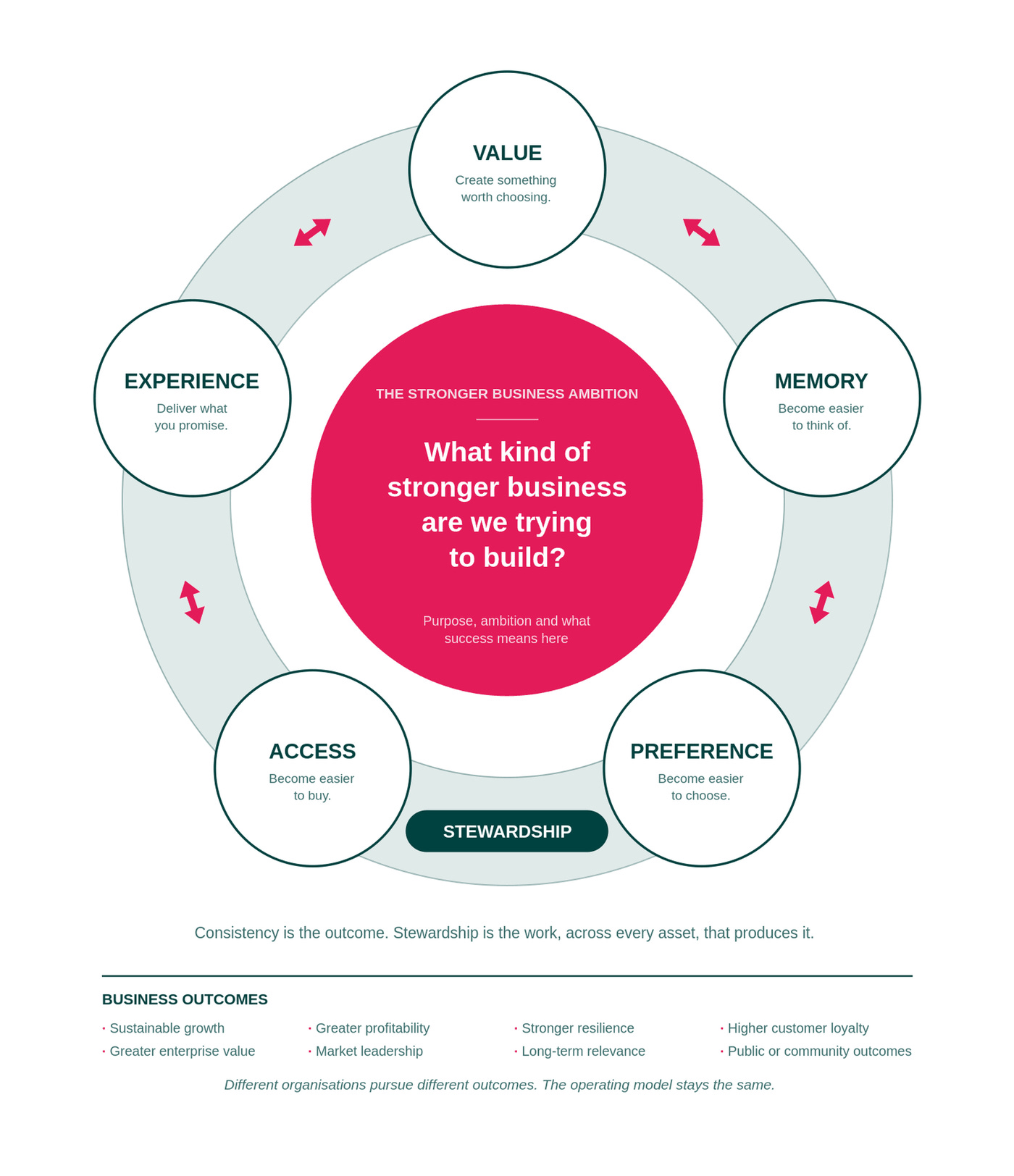
The full Stronger Business Operating Model is here: ++https://somethingdifferent.co.nz/musings/the-stronger-business-operating-model.html++.
Who in your business is responsible for ensuring next year starts from a stronger base than this one, and do they know it is their job?