Five strong assets are not the goal
Five strong assets are not the goal
Why scoring five things out of five is the wrong instrument, and what to use instead.
When I first sketched what became the Stronger Business Operating Model, it was a doodle in my notebook with five assets on it. My original thinking was that if you improved each of the five every year, you would steadily increase your chances of building a stronger business. So I scored each asset out of five. It was the obvious thing to do once you have five of anything, and it produces a satisfying chart, usually a spider diagram, with a shape that everybody can look at and discuss.
The more time I spent with it, and the more clients I ran through it, the more I realised I should stop doing that, because the chart steered every conversation towards the same conclusion. Get the low scores up. Make the shape rounder. Aim, eventually, for five fives. That conclusion is wrong for almost every business, and a chart that keeps pointing people towards it does harm, no matter how rigorous it looks.
Symmetry is not strength
Think about how differently successful businesses are shaped.
A convenience business wins mostly on access. It does not need to be anybody’s favourite; it needs to be there, open and easy, at the moment somebody needs it. A luxury brand does the opposite. It deliberately restricts access, because being hard to get is part of what it is worth. A specialist professional firm leans heavily on value and experience and may be almost unknown outside the small group of people who buy from it. A mass-market consumer brand leans on memory and access, which is more or less what the Ehrenberg-Bass Institute means by mental and physical availability.
Each of those businesses would score poorly on at least one asset, and each would be making a mistake if it spent heavily to fix that score. The luxury brand that makes itself easier to buy can damage its value. The specialist firm that spends to become famous with the general public has bought memory among people who will never be customers.
Aiming for five equal scores spreads investment evenly across all five and builds none of them to the level that actually matters for the business you are trying to become. It looks balanced. It is mostly a way of avoiding a choice. If you have read any of my previous articles, you will know that strategy is about making choices: saying yes to the things that matter most and no to the things that don’t, at least for this year.
Fit, not symmetry
The better question is not how strong each asset is. It is what shape of strength the business needs, given what it is trying to become.
That is why, in the Stronger Business Operating Model, the Stronger Business Ambition sits at the centre of the diagram. The five assets are not assessed against a universal standard. They are assessed against the ambition. A business that wants to be the easiest option in its category needs a different shape from one that wants to be the one people are proud to have chosen, and both need a different shape from one that wants to be the obvious specialist.
Once the ambition is clear, some assets matter a great deal, and others need only be good enough. Good enough is a real standard, not an excuse. An asset that falls below it will hold everything else back, which is the argument I made earlier in this series about the binding constraint: the one thing limiting the whole business. But above that threshold, more is not automatically better, and the money is usually more useful elsewhere. That matters because very few businesses sit on piles of cash and can do everything. Choices have to be made, and while nothing is guaranteed in a moving market with fickle customers, getting them wrong can do lasting damage to a business’s prospects.
The Asset Posture
What I use now instead of a score is what I call the Asset Posture. For each asset, the leadership team agrees on a stance rather than a number.
Five postures cover almost every situation:
- Protect is for an asset that is already strong and strategically important, where the job above all is not to weaken it.
- Strengthen is for one that matters and can create more value, where investment should be deliberate.
- Repair is for an asset whose weakness is constraining the whole system.
- Maintain is for one that is strong enough for the role it needs to play, where the discipline is not to overinvest.
- Reconsider is for an asset that no longer supports where the business is going, and needs to change on purpose rather than by drift.
I appreciate that the difference between a posture and a score may sound small. It turns out not to be.
A score invites averaging, comparison and the instinct to raise whatever is lowest. A posture forces a choice.
You cannot strengthen all five at once, so choosing what to strengthen means deciding what you will only maintain. That is a strategic decision in a way that raising a three to a four is not.
A posture is also an instruction. Everyone in the business who comes into contact with an asset knows what they are supposed to do with it: protect it, strengthen it, repair it, maintain it or reconsider it.
That makes it a natural partner to stewardship, and the work of looking after assets over time. Think of how many strategy days you have sat through that ended with a big document and nothing much happening afterwards. Stewardship stops that. It makes sure everyone knows their role, that the right goals and measures are in place, and that someone is responsible for seeing the improvements through, so the effort creates momentum rather than busyness. A score tells you where you are. A posture tells everyone what to do next, and what to leave well alone.
Where this leaves the chart
I still use the diagram below, with clients and in these articles, because it helps paint a picture of the five assets and shapes the conversation. In a workshop, though, what gets drawn on it is posture and direction (which assets we are protecting, which we are strengthening, which are wearing away), not a number on each leg of a spider diagram. It starts better conversations, and it ends them with decisions rather than a list of things to improve. Most businesses, and most departments within them, already have long lists of things to do this quarter or this year, with little chance of getting through them all and not always knowing which items will have the greatest impact.
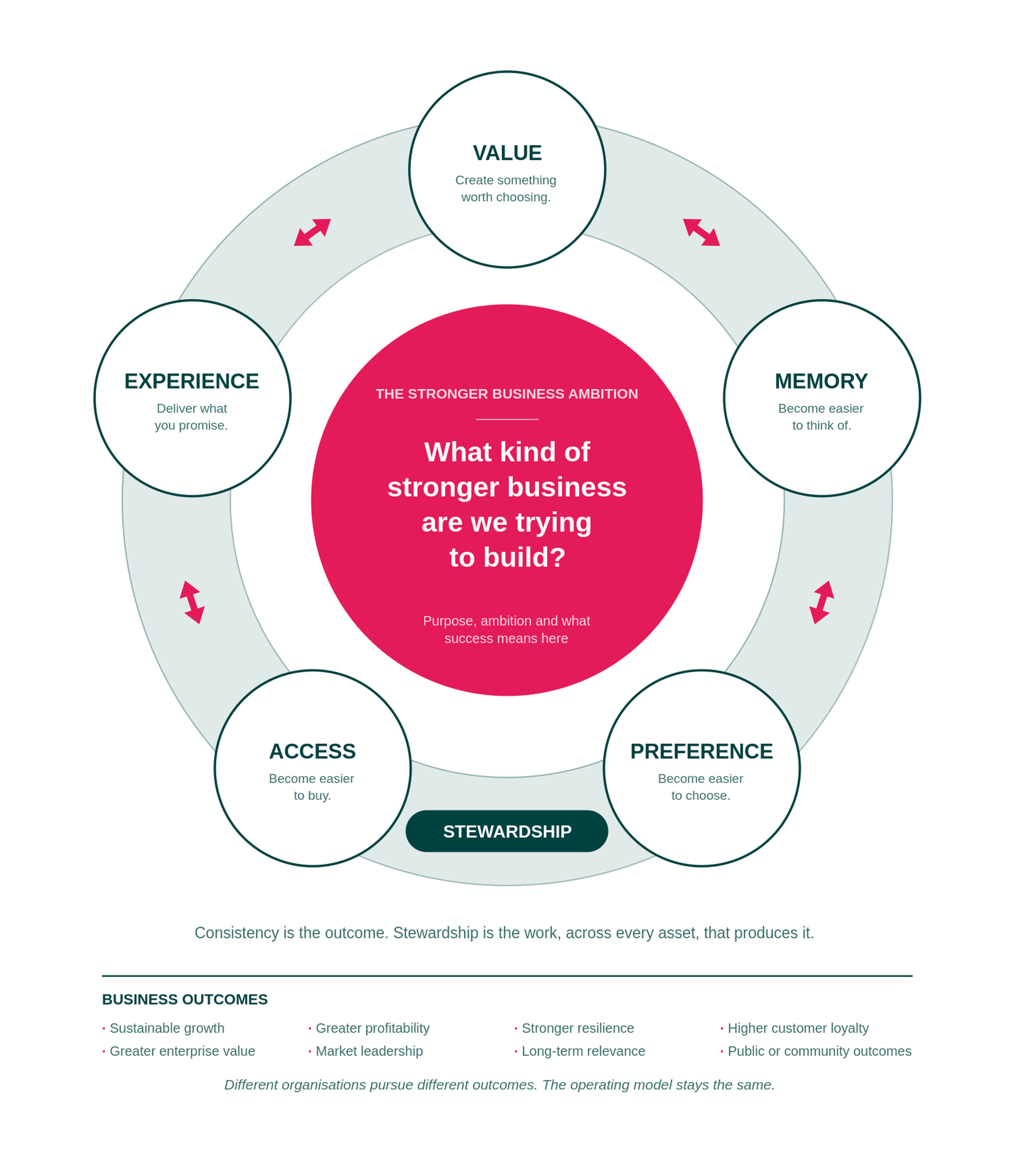
The full Stronger Business Operating Model, including the Asset Posture, is here: ++https://somethingdifferent.co.nz/musings/the-stronger-business-operating-model.html++
The takeaway question tests how clear the ambition really is. If you asked each member of your leadership team to name the one asset your business intends to be distinctively strong at, would they all name the same one?