
One model, four lenses: Making sense of modern marketing best practice
If you were to go out into the world and find yourself five accomplished marketers and ask them what “best practice marketing” looks like, I’m fairly sure that you will get five confident, but different, and quite possibly incompatible answers. Which, I appreciate, will probably not be helpful.
One will talk about reach and building mental availability. Another will insist that the most important thing for any marketer or advertising practitioner is attention. The third will point to precision, dashboards and first-party data. The fourth will already be heavily invested in how their brand surfaces in LLMs and AI assistants, since that is the direction they believe we are headed, as most humans have (or will have) handed over the reins to machines. Each will be right, in part, for the AI proponent, but each will also be incomplete on its own.
If you spend a bit of time scrolling through LinkedIn or Substack, you’ll see marketing and its effectiveness split into distinct schools, each with its own thinkers, evidence, and vocabulary.
No wonder business and marketing leaders struggle to understand where to put their efforts. All too often, a strategy conversation turns into a turf war, with the louder voices, backed by heavy investment and content from those who own the shiny new things, being the ones gaining the majority of funds, with the other, currently more important schools of thought losing out, usually to the detriment of the business.
The more useful way to see it is that these aren’t four competing ideologies. They’re four lenses on the same problem: how brands actually grow, and how you make sure your investment behind that growth is real, not assumed. Read together, they form a single system. And the newest lens: planning for an AI-mediated world doesn’t overturn the older ones. It re-validates them.
As an important aside, when I say growth, I don’t just mean business growth, market share, or revenue; I also mean memory, preference, margin, profit, pricing power, resilience, or anything else that helps you build a stronger business.
The four schools
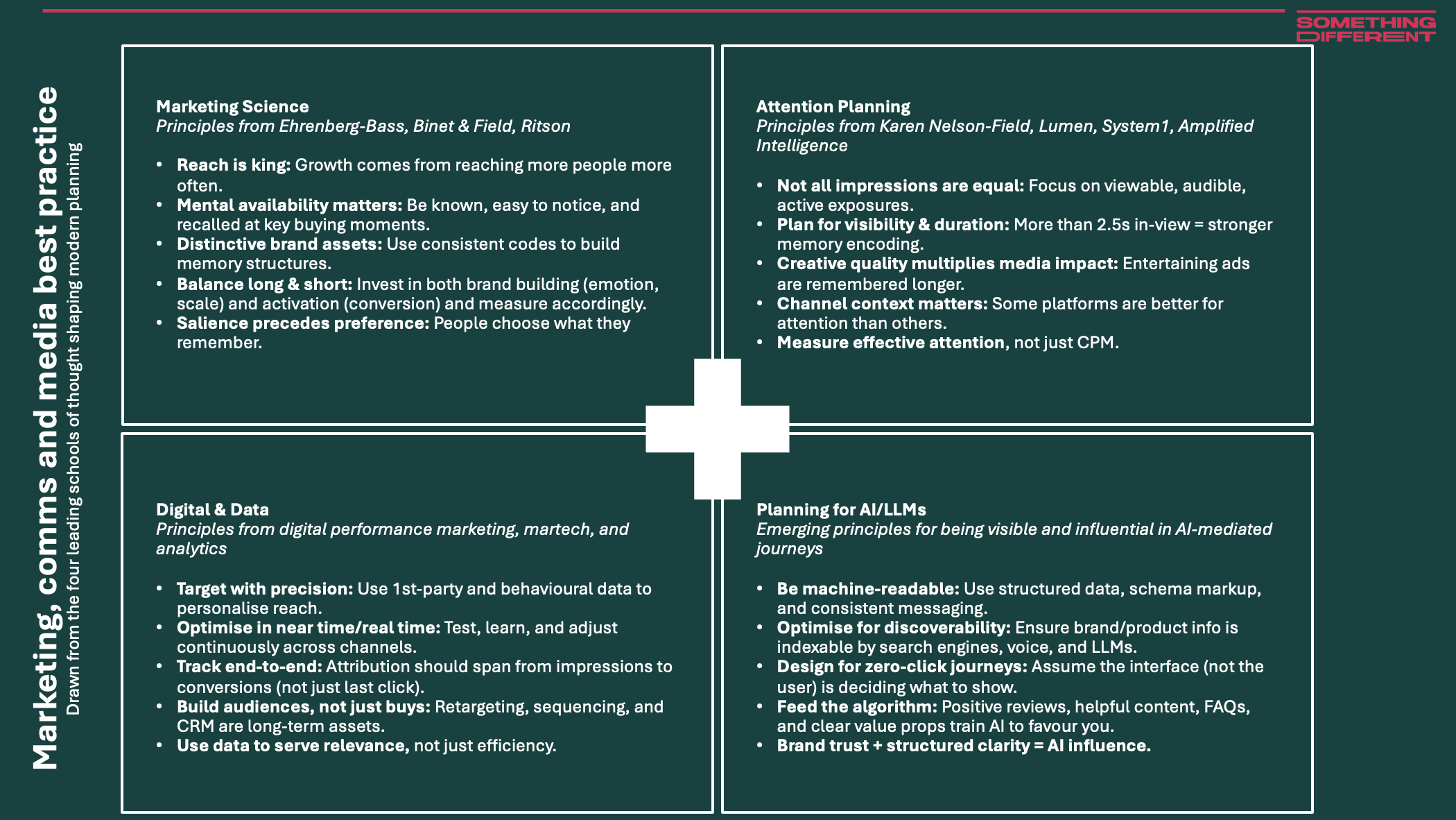
Marketing Science - the physics of growth.
This is the settled canon, built on the empirical work of the Ehrenberg-Bass Institute, Binet and Field’s long-and-short research, and Mark Ritson’s relentless pragmatism. Its core claims are unfashionably simple and unusually well evidenced: brands grow primarily by reaching more people, more often; growth comes from penetration, not loyalty; you win by being easy to bring to mind (mental availability) and easy to recognise (distinctive assets); and you have to invest in both long-term brand building and short-term activation, because they do different jobs on different timescales. Salience precedes preference: people choose what they remember, not what they’ve been rationally persuaded to prefer. This school tells you what drives growth and why.
Attention Planning - the auditor.
If Marketing Science says reach matters, the attention school - Karen Nelson-Field’s work, Lumen’s eye-tracking, System1’s creative testing - asks the uncomfortable follow-up: reach that actually landed? The digital era manufactured enormous quantities of cheap “reach” that was never seen, never heard, never encoded into a single memory. Attention planning re-introduces quality into the reach equation. Not all impressions are equal; viewable, audible, active exposure is what counts; memory imprinting meaningfully strengthens after more than a couple of seconds in view; and creative quality multiplies the media effect rather than sitting beside it. This school isn’t a rival to Marketing Science; it’s its quality-control function.
Digital & Data - the execution layer.
This is the discipline of performance marketing, martech and analytics: target with greater accuracy using first-party and behavioural data, optimise in near time, track end-to-end rather than crediting the last click, treat retargeting and CRM as long-term assets, and use data to serve relevance rather than merely to chase efficiency. This is the school most likely to be mistaken for the whole of marketing, because it’s the one with the dashboards. It tells you how to execute and optimise, and its greatest risk is being run as a strategy in its own right rather than as the machinery that serves one.
Planning for AI/LLMs - the emerging frontier.
The newest lens. As discovery increasingly runs through search engines, voice assistants and large language models, a brand’s visibility depends on being machine-readable (structured data, schema, consistent communications), discoverable across AI surfaces, and designed for journeys where the interface, not the user, decides what to show. Positive reviews, helpful content and clear value propositions increasingly train these systems to favour you. This school asks a genuinely new question: how do you stay visible and influential when a machine mediates the moment of choice?
Where the schools fight and how to stop them doing so
If one were to make an honest assessment of the four schools’ agreeableness, they would no doubt conclude they don’t perfectly agree.
They may find the greatest tension between Marketing Science and Digital and Data. One says reach broadly: penetration, focus on light buyers, and as many of the many as budget will allow. The other will say target precisely: segments, signals, the few.
As I’m no doubt sure that you’ll see that if these are taken as ideologies, worth fighting over by both sides, they are opposites, and if you were to look over the marketing arguments of the past 10-15 years, these are the two opposing sides you’ll find on the marketing battlefield.
Clearly, well, clearly as I can see it, the solution isn’t to pick one side over the other, but to see that they operate at different levels. Levels that should be pulling in the same direction for the betterment of the business.
To give you a balanced view, reach is the strategic objective, with precision (used appropriately) as the execution capability that serves that objective.
Data then lets you buy broad reach more efficiently, stripping out waste (where appropriate, as supposed wastage can be useful when brand-building), and sequence messaging, without abandoning the logic of penetration, that thing that actually fuels growth.
If you were to lean too heavily into precision, allowing it to become your strategy, you will redefine success as efficiently reaching people who were already going to buy you, which mountains of data, insight, knowledge, and wisdom on marketing effectiveness will show is the way to brand stagnation. Please remember, dear reader, that data should serve the strategy, never become the strategy itself.
Thanks to Karen Nelson-Field and the teams at WARC and Lumin, attention planning keeps the whole system honest. It sits between the strategic claim that reach matters and the executional reality that digital delivers cheap impressions, and it kindly audits whether all that reach you are paying for actually did anything positive. That’s why it belongs in the middle of the model and not off to one side. If someone doesn’t see and understand what you’re saying. What’s the bloody point?
The fourth lens re-validates the first
Here’s what makes this system worth writing about now rather than five years ago (or even 12 months ago, when I first published it). It would be easy to treat the AI quadrant as a break from everything before it; a new game in town with a new set of rules. However, it is much closer to the opposite.
Think about what an LLM actually does when it recommends a brand. It surfaces what is well-known, consistently described, clearly associated with a category, and widely trusted. That is mental availability and distinctive assets, rendered machine-legible. “Be known, easy to notice, and recalled at key buying moments” was Ehrenberg-Bass advice for human memory; it turns out to be remarkably good advice for becoming retrievable by a model, too. Brand trust plus organised clarity equals AI influence, the machine-era expression of salience preceding preference.
So the fourth lens doesn’t retire the first. It raises the stakes on it. The brands best positioned for an AI-mediated world are largely the brands that already did the unglamorous work of building broad awareness, consistent codes, and genuine trust. The newest thinking points straight back at the oldest. The time has come to build brand preference for humans and machines.
A quick word on the evidence of this piece
For the sake of intellectual honesty, we need one caveat that will strengthen the framework rather than weaken it, if I make it clear.
These four lenses don’t sit on equal evidence. Decades of peer-reviewed, replicated research sit behind the Marketing Science and Attention Planning quadrants, so every business that wants to sell something to someone should consider and implement both.
Digital and Data is also well proven, even though much of it can be rather wasteful and ineffective, especially in the wrong hands. It is certainly messier, hello attribution, than the first two.
The AI quadrant, being the newest, is the least settled, with a set of sensible, well-reasoned heuristics for a landscape that is very much still forming, no matter what the current experts may say. I still believe it deserves its place in the model because the direction we are travelling in is clear. Senior leaders should still treat it as the informed bet it is, not as established marketing law, and hold their AI-visibility tactics more loosely than their reach and attention principles. As time passes, and you can already start to see it, things in this space will be a bit more sure-footed.
What this means for how you plan
The main takeaway for any marketer or leadership team is not to adopt a single school. Instead, my advice is to stop thinking in schools at all.
The job is to be clear on what you are trying to achieve, where you are trying to take your business, and to orchestrate across all four lenses, roughly in sequence, to get you there best.
Get your strategy right (Marketing Science), verify that it lands (Attention), execute and optimise it as accurately as you can (Digital & Data), and start preparing (if you aren’t already) for the change in how brand and product discovery now happens for many potential buyers (AI).
I believe a plan that is strong in one quadrant and blind in another isn’t adopting a modern marketing plan; it is a well-defended blind spot.
Best practice, in other words, was never a single discipline you could master. It’s a system you have to keep in balance. The marketers who’ll win the next few years aren’t the ones who pick the right school. They’re the ones who refuse to, the ones who use the best parts of each to build a stronger business.