
Show Me The Incentive
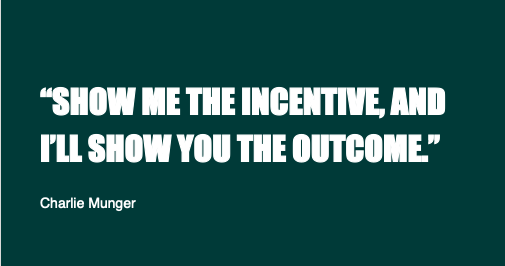
Charlie Munger, who spent most of a long life thinking about why people do what they do, had a favourite story about FedEx. (He told it so often it became a kind of party trick.)
FedEx had a problem. The whole network depended on the night shift getting every package sorted and loaded before the planes left. The shift kept running late, and nobody could work out why. They tried lectures. They tried pleading. They presumably tried the corporate equivalent of thoughts and prayers. Nothing worked.
Then someone noticed the workers were paid by the hour. Of course, the shift ran late. Every extra hour was extra money. So FedEx changed it. They paid people per shift and told them they could go home the moment the work was done. The problem disappeared more or less overnight.
Munger's point was not that the workers were lazy or dishonest. It was that they were behaving exactly as their incentives dictated. "Show me the incentive," he said, "and I'll show you the outcome." And then the part people usually leave off: he reckoned he was near the top of his field at understanding the power of incentives, and he had still underestimated them his entire life.
Hold that thought, because marketing has an incentive problem. Several of them, actually.
Not every marketing problem comes down to incentives. Capability matters. Creativity matters. Leadership matters. But once you start looking through Munger's lens, it's remarkable how many supposedly complex problems turn out to be remarkably simple.
We are often getting exactly the behaviour we've chosen to reward.
The clock you're paid against
Start with time. Most of the people deciding how to spend a marketing budget are paid against a clock that runs faster than the thing they are trying to build.
Brands are built over years. Mental availability, the degree to which you come to mind in a buying situation, accumulates slowly and decays slowly. Binet and Field spent the better part of two decades showing that the campaigns which actually grew businesses split their money roughly 60/40 between long-term brand building and short-term activation. Get the ratio wrong, tilt too far towards the short, and you get a sugar hit followed by a slow bleed.
So why does almost everyone tilt too far towards the short term anyway?
Because of the clock. The average tenure of a chief marketing officer is measured in a couple of years, not a couple of decades. Quarterly numbers get reported quarterly. Bonuses are paid against in-year sales. If you are a marketer who will probably have moved on before the long-term payoff arrives, and who gets judged this quarter on this quarter, you are going to spend on the thing that moves this quarter. You are not being short-sighted. You are being rational. The incentive is short, so the outcome is short.
Nobody in that chain is a villain. They are all just FedEx night-shift workers, paid by the hour, behaving accordingly.
The measurability trap
Munger had another line for this one. To a man with a hammer, every problem looks like a nail. Hand marketing a tool that measures clicks with beautiful precision, and watch every problem suddenly become a click problem.
This is the measurability trap, and it is probably the most expensive habit in the industry. We do not optimise for what matters. We optimise for what we can measure. And the two are not the same thing.
Search, retargeting, and last-click attribution are gorgeously, seductively measurable. You can watch the dashboard update in real time. Brand building is not. The reach campaign that planted a memory in someone who buys you in fourteen months shows up on no dashboard, attributed to nothing, claimed by nobody. So, guess which one gets the budget when times are tight, and somebody needs a number to defend.
The trouble is that the measurable channels are often just harvesting demand the unmeasurable ones created. Retargeting did not make the sale. It took the credit for it. (Retargeting is the colleague who joins the meeting in the last five minutes, says one obvious thing, and somehow ends up named in the success email.) Karen Nelson-Field's attention work keeps making the same uncomfortable point from a different angle: the metrics the industry trades on, the impressions served, the completion rates, and the viewability scores are not the metrics that predict whether anyone actually remembered you. They are just the ones that are easy to count.
One of the cleanest examples was Pepsi Refresh. In 2010, Pepsi skipped the Super Bowl and redirected around $20 million into a social-good campaign where people voted for community projects to receive grants. Engagement exploded. More than 80 million votes were cast, millions followed the campaign, and awareness soared. By almost every digital metric, it looked like a spectacular success.
Meanwhile, Pepsi slipped behind Diet Coke for the first time in its history, a decline estimated to have cost hundreds of millions of dollars in lost market share. The programme was quietly abandoned within two years.
The campaign delivered exactly what it was designed to deliver: engagement. The incentive was to report impressive marketing metrics, and it delivered exactly that. Whether those metrics translated into commercial success turned out to be a very different question.
Interestingly, finance teams are often accused of "not understanding brands". I'm not convinced that's true. More often, they're responding to their own incentives. They're expected to allocate capital to investments whose returns can be explained and defended. If marketing can't explain the long-term commercial value of brand investment, finance will quite rationally favour the things that produce immediate numbers. The incentive problem isn't confined to marketing. It exists on both sides of the boardroom table.
Everybody in the chain is selling something
Now widen the lens to the media itself, because this is where the incentives get genuinely ugly.
When you buy programmatic advertising on the open web, your dollar passes through a long chain of intermediaries, each of whom takes a cut, and each of whom is incentivised to keep the dollar moving rather than to ask whether it is doing any good. The Association of National Advertisers ran the numbers in 2023, and the result should be pinned above every media buyer's desk. Of every dollar that enters a demand-side platform, only about 36 cents reaches an actual human being. Of the roughly $88 billion open web programmatic market, about a quarter, some $22 billion a year, was simply wasted, a good slice of it pouring into "made-for-advertising" sites that exist for no purpose other than to carry ads to nobody.
Read that back. Nearly two-thirds of the money evaporates before it reaches a person, and a quarter of the entire market is waste.
This is not a glitch. It is the system working as designed, because the system was designed by the people who take the cut. The ad-tech vendor is incentivised to sell you more inventory, not better inventory. The platform is incentivised to maximise impressions sold and time on site, not your sales. The made-for-advertising site is incentivised to manufacture impressions out of thin air. Not one of them is incentivised to tell you to spend less. Show me the incentive, and I'll show you the $22 billion.
The advice you're taking (including this)
Here is the part that should make all of us slightly uncomfortable, me included.
A lot of marketing decisions are made on advice. From agencies, from platforms, from consultants, from the trade press. And almost everyone offering that advice has an incentive that is not perfectly aligned with yours.
The agency paid on a percentage of media spend has a quiet reason to recommend more media spend. The platform's "best practice" guide will, by a remarkable coincidence, recommend the practices that are best for the platform. The trade press is incentivised towards novelty, because "the boring fundamentals still work" has never once gone viral, whereas "the death of the funnel" gets shared all day. And the consultant, all too often, has an incentive to find a problem that happens to match the solution they sell.
Munger called this incentive-caused bias, and the unsettling thing about it is that it does not require anyone to be lying. The agency genuinely believes more spend is wise. The platform genuinely believes its tool is the answer. People are extraordinarily good at sincerely believing whatever pays them. That is precisely what makes it dangerous. You cannot catch it by looking for dishonesty, because the dishonesty usually isn't there.
What to actually do about it
So far this has been a tour of bad news, which is the easy half of any article. The harder and more useful question is what you do once you accept that the whole industry runs on misaligned incentives.
The first move is the one Munger built an entire career on. Invert.
Every recommendation deserves one question before anything else:
"What outcome is the person giving me this advice rewarded for creating?"
Don't ask whether they're honest. They probably are. Ask what success looks like from their perspective. Quite often, the answer explains the recommendation better than the recommendation itself.
The second move is to stop trying to fix the parts you do not control and fix the parts you do. You cannot reform the programmatic supply chain from your desk, and you cannot make the platforms grade their own homework honestly. But you can decide what gets rewarded inside your own organisation, and that is where the leverage actually sits. If your internal scorecard only rewards the measurable short-term stuff, your people will quite reasonably deliver measurable short-term stuff, and they will be right to. Put the long-term brand measures on the dashboard the board actually looks at. Reward the thing you say you want, or stop being surprised when you get the thing you least reward instead.
Third, lengthen the clock wherever you have the authority to. If a marketer is judged only on the quarter, they will spend only for the quarter, and no amount of Binet, Field, and Hurman will change that. Change the review horizon, and you change the behaviour, without having to win a single argument about brand building. The incentive does the persuading for you.
Fourth, separate the measurable from the meaningful, on purpose, out loud, in the room. Keep measuring the easy things, by all means, but stop letting them crowd out the things that matter and happen to resist a tidy number. Sometimes the most important line in the plan is the one with no dashboard attached. Say so. Defend it. The fact that something is hard to measure is not evidence that it does not work. It is only evidence that it is hard to measure.
And finally, be most suspicious of the advice that is most profitable for the person giving it. Not cynical. Suspicious. There is a difference. Good agencies, good platforms and good consultants exist in large numbers, and you will need them. But the right amount of trust to extend to anyone's advice is roughly inverse to how much they make when you take it. Mine included.
Which is also why I include myself in this. Consultants aren't somehow exempt from incentive-caused bias. It's remarkably easy to recommend the work you're good at, to notice the problems your methods are best equipped to solve, and to become sincerely convinced that your preferred approach is the obvious answer. Most of us aren't trying to mislead anyone. We're simply seeing the world through the incentives that shape our own success. Munger's warning applies as much to those giving advice as those receiving it.
The outcome you're paying for
The uncomfortable truth underneath all of this is that the marketing you have is, to a remarkable degree, the marketing your incentives ordered.
The short-termism. The obsession with dashboards. The budgets flowing towards whatever is easiest to measure. The endless optimisation of numbers that were never the goal in the first place. None of it is really a competence problem.
It's an incentive problem disguised as a competence problem. Which is oddly encouraging. Competence takes years to develop. Changing incentives can happen on a Tuesday afternoon.
You can change what gets measured. You can change what gets rewarded. You can change how long you're prepared to wait before judging success. And when you change those things, people don't suddenly become smarter. They simply start behaving differently. Exactly as Munger predicted they would. Because organisations, like people, optimise for whatever success looks like.
Every team optimises for its scorecard. Every agency optimises for its brief. Every platform optimises for its business model. Every marketer optimises for the KPIs they're rewarded against.
If you don't like the outcome, don't start by asking who failed. Ask what success was paying them to achieve. Because the question Charlie Munger spent a lifetime asking wasn't really about incentives at all. It was about responsibility.
What, exactly, are we rewarding?
Because every organisation eventually becomes perfectly designed for the behaviour it rewards.