
The most dangerous position in business is performing well
The most dangerous position in business is performing well
Financial results tell you what a business produced. They cannot tell you whether it can produce it again.
Most businesses go through a situation very few notice. Revenue is fine. Margin holds. The board pack is mostly green. And underneath all of it, the business is getting weaker.
It is the hardest problem in commercial life, and the reason is simple. Nothing sets off an alarm.
Weak results in a weakening business are obvious, and at least they are visible. Weak results in a strengthening business are uncomfortable, but they are usually transitional, and a leadership team with any nerve can hold the line through them. Strong results in a strengthening business are what everybody wants, and only a few people earn. But strong results produced by a business quietly consuming what earlier investment built do real damage, because the numbers let everyone look away.
I have watched this happen to good companies run by very capable people. It never arrives as a decision, or a single issue; it accumulates over time.
Why the numbers cannot show you
Financial reporting measures what a business produced. It cannot measure the capacity to produce it again, and it was never designed to.
A company can increase this month’s revenue while weakening next year’s pricing power. It can also boost its media efficiency whilst becoming more dependent on paid acquisition every quarter. It can hit the sales number while teaching its customers to wait for the discount. It can cut costs while removing what kept people. Each of those is a good number this period and potentially a smaller business next period, and nothing in a profit and loss statement distinguishes between any of them.
That means by the time deterioration shows up in the financials, it has usually been running for years. The decline looks sudden when it arrives. The causes seldom are.
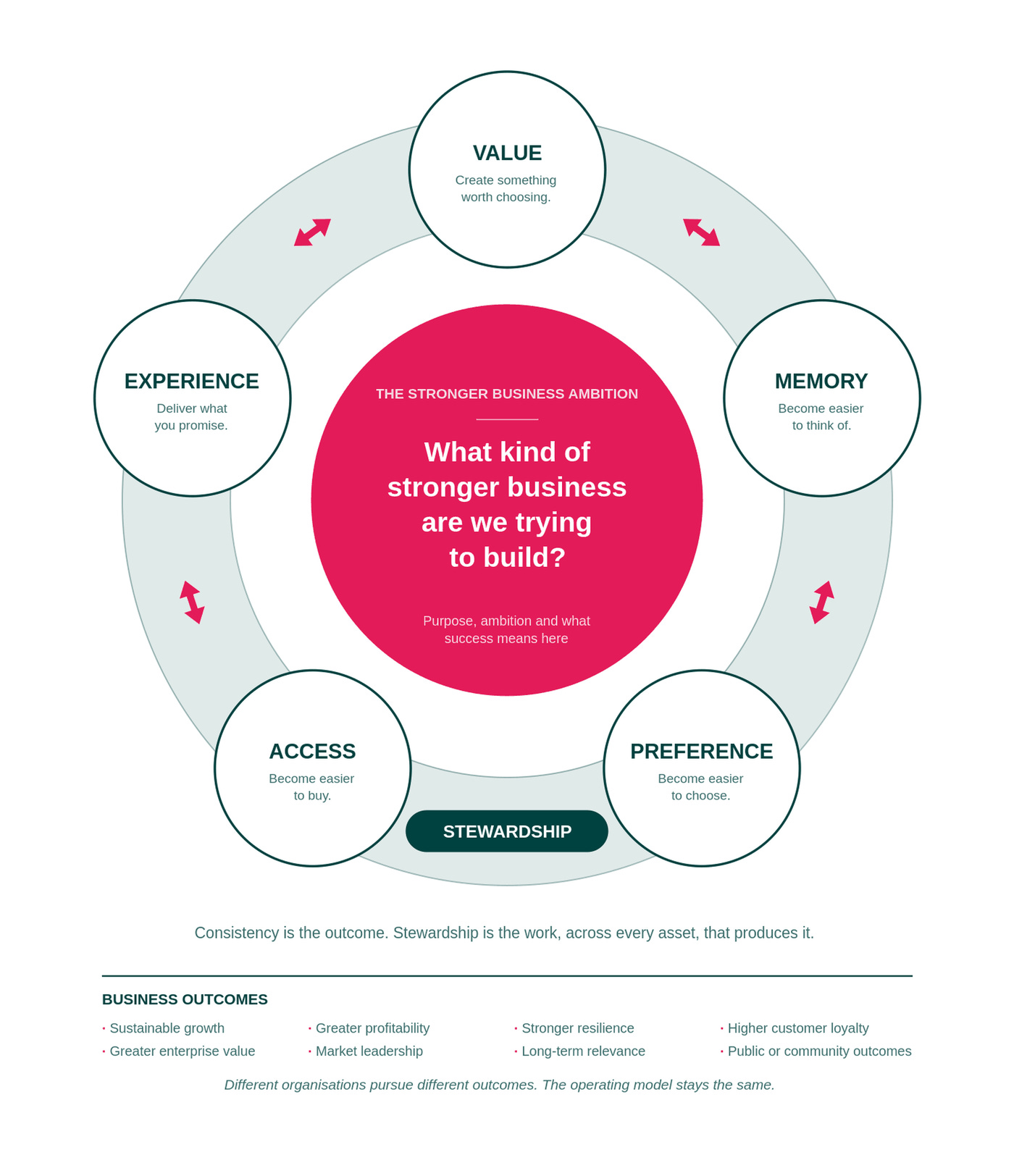
Strength also isn’t a universal destination. A stronger business might mean faster sustainable growth, greater profitability, more resilience, stronger customer loyalty, greater enterprise value or better public outcomes. The destination changes. The things that allow an organisation to keep creating value do not.
What is actually eroding
Strong businesses do not accumulate activity. They accumulate assets, and not the kind that appear on a balance sheet.
Five of them determine how readily a business can turn what it does into sustained demand.
- Value is the customer’s judgement that choosing you is worth what they have to give up.
- Memory is whether you come to mind at all when someone is choosing.
- Preference is whether the balance of choice leans your way when someone has alternatives in front of them.
- Access is whether a person who has decided to act can actually do so without needless effort.
- Experience is the evidence that tells them whether choosing you was a decision worth repeating.
Call them assets and something useful follows. An asset can be invested in. It can be measured. It can appreciate. You can neglect it, and you can spend it.
Most importantly, an asset keeps working after the activity that created it has stopped. An advertisement disappears; its memory can remain. A sales conversation ends; the trust it built can remain. That is the difference between buying an outcome and building something.
A business that harvests these five without replenishing them can look efficient, and sometimes for a bloody long time.
Its awareness reflects investment made years ago. Its reputation reflects experiences delivered by people who may have left. Its pricing power comes from a proposition that was stronger than it is now. For a while, the numbers hold. Then they do not.
They are not a list, and they are not a funnel
It is tempting to read five things in a row as a sequence. Create value, build awareness, earn preference, make it easy to buy, deliver well. Neat, and wrong.
Experience, for instance, creates some of a business’s strongest memories. Access changes what people think something is worth because convenience is valuable in itself. Preference shapes how people interpret an experience before it even happens. Relationships run in every direction and continue continuously, which is why the commercial outcome comes from the system rather than any one part of it.
That has a consequence worth sitting with. Strength in one place cannot indefinitely compensate for weakness in another. A business with an excellent product and no presence in anybody’s memory underperforms, not because the product is wrong but because too few people ever consider it. A business people genuinely prefer but find difficult to buy from loses demand it has already paid to create. A business with strong acquisition and a poor experience spends continually to replace customers it could have kept.
Your weakest asset is not automatically your biggest problem
This is the part that changes what leadership teams do on Monday.
The instinct, when you lay five things out and assess them, is to find the lowest one and fix it. It feels rigorous. It is usually wrong. An asset can be weak without mattering much to the business you’re trying to build, and another can be in reasonable shape while still holding everything else back.
So the question isn’t which one scores lowest. It’s which one is constraining the system. And the second question matters just as much: where do you already have strength that another weakness is preventing you from exploiting?
Strong value that too few people know about is trapped value. Strong preference wasted by a difficult buying process is trapped demand. Often, the fastest route to a stronger business isn't building something new. It is releasing something that already exists.
Consistency is the outcome. Stewardship is the work
None of these five holds their value on their own.
Value drifts as what customers want shifts. Inconsistency erodes memory faster than silence. Preference weakens quietly when competitors improve. Access deteriorates as buying behaviour shifts around a business that hasn’t changed with it. Experience declines as organisations grow, cut costs, or lose interest.
Everybody agrees consistency matters. Far fewer treat it as work.
Consistency is the outcome an organisation wants; stewardship is the work that produces it. It happens across all five, not alongside them: protecting what creates value, strengthening what is weak, and changing what has to change without needlessly destroying what has already been built.
When that discipline is missing, organisations repeatedly pay to rebuild advantages they could have been compounding all along. New leadership reopens settled questions. A rebrand discards years of recognition because the new team wants to make its presence felt. A cost programme removes the thing customers valued most. None of it was irrational at the time. All of it means starting again.
With discipline, each work cycle starts from a stronger base than the last. That is the whole argument for treating these five as assets rather than as activities.
Two questions worth asking this week
If you do nothing else with any of this, ask your leadership team two things and pay close attention to how quickly they can answer.
Of everything in the board pack, what tells us whether the business is becoming stronger rather than simply reporting what it produced last quarter?
And which of this year’s results came from investments we no longer make?
The second one is uncomfortable in a healthy business and almost unanswerable in an unhealthy one. That is what makes it useful.
Every business already has an operating model
The question is only whether it was designed deliberately or arrived by accident.
Most of the ones I meet arrived by accident, which isn't a criticism of anyone. It happens when a business grows through a series of individually sensible decisions made by different people at different times for different reasons. The result is a business that works, nobody fully understands, and nobody is quite responsible for.
The alternative is to make it explicit.
- What kind of stronger business are we trying to build?
- What five things determine whether we get there?
- Which one is holding the others back?
- And who is responsible for making sure what we build compounds instead of resetting?
That is the Stronger Business Operating Model. I have written the full model up and ++made it freely available++.
Over the next few months, I am going to take it apart one piece at a time.
Start with the second question. Which of this year’s results came from investments you are no longer making?