
Your weakest asset is not your biggest problem
Your weakest asset is not your biggest problem
Fixing the lowest score is the most rigorous-looking way I know to waste a year.
I’ve come to recognise a moment in most strategy workshops. Something gets assessed, usually on a whiteboard, usually with coloured dots. A few items come out well, one comes out badly, and the room relaxes because it's now obvious what to do. Fix the weak one. It feels disciplined. It feels like the conclusion the evidence was pointing to all along.
It is usually the wrong conclusion, and understanding why matters, because it applies well beyond workshops.
Weak compared with what
Take a business that makes a specialised component for the construction industry. It is an illustration rather than a client, but it will be familiar to anyone who has worked in that world. Ask the general public whether they have heard of it and almost nobody has. Score its memory against any consumer brand, and it comes last by a distance.
But it sells to three hundred buyers, and all of them know exactly who it is. Its memory among the people who matter is fine. What isn't fine is that a quote takes three weeks to come back, and in that time the buyer has usually gone with someone who replied on Tuesday. Access might score a little better than memory on the whiteboard. It is still the thing holding the whole business back.
An asset can be weak without mattering much to the business you are trying to build. Another can look reasonable and still be the system's narrowest point. The score tells you about the asset. It does not tell you about the business.
The narrowest point
Eliyahu Goldratt made a similar argument about factories in The Goal forty years ago. A production line's output is set by its slowest step, and improving anything else does little for the line as a whole. You can double the speed of every other machine and still ship the same number of units because the constraint hasn't moved.
Demand behaves in a similar way. People must think of you, lean towards you, judge you worth the price, be able to buy, and have a good enough time that they come back and perhaps tell others. A business can only create as much demand as its most limiting asset allows. Money spent strengthening one of the other four isn't exactly wasted, but it tends to pile up behind the constraint rather than flow through to results.
So the first question isn't which asset scores lowest. It is which one is currently limiting the whole.
Trapped strength
The second question is the one I find leadership teams have usually never asked, and it is often the more valuable of the two.
Where do you already have strength that something else is stopping you from using?
Strong value that too few people know about is trapped value. The product is good, the customers who find it love it, and it grows slowly because no one has it on their short list. Strong preference behind a difficult checkout is trapped demand. People want to buy and give up halfway. An excellent experience nobody hears about is trapped reputation: a business doing the hard part well and failing to get credit.
The reason this matters is speed. Building a new strength takes time and money, and some assets take years. Releasing a strength you already have often comes down to removing an obstruction. The value was already there. The preference was already there. You are not creating anything; you are letting something that exists reach the people it was meant for.
That is why, in my experience, the fastest route to a stronger business is often not building something new. It’s figuring out what is already strong and what is standing in its way.
How to find it
There is no formula, but three questions I find useful tend to get a leadership team to the answer faster than any scoring exercise.
Where does demand we have already created leak away? Every business has places where interested people stop. The enquiry that goes unanswered, the abandoned shopping basket, the trial that never becomes a contract. The biggest leak is a strong candidate for the constraint.
Where are we strong and not being paid for it? This is the trapped strength question in plain language. It usually surfaces something the organisation is quietly proud of and has never quite capitalised on.
And if this one asset improved, would the others follow? The constraint is usually the asset whose improvement would free up the most of the other four. If fixing something would leave the rest of the system exactly where it was, it probably is not the constraint, however poorly it scores.
The constraint moves
One last thing, because it catches people out. Once you relieve the constraint, another asset becomes the narrowest point. That is not failure; it is progress. A business that fixes its quoting process and suddenly finds that its memory among a wider set of buyers is holding it back has grown into a better problem.
This isn't a question you answer once. You ask it every planning cycle, and the answer will change as the business does.
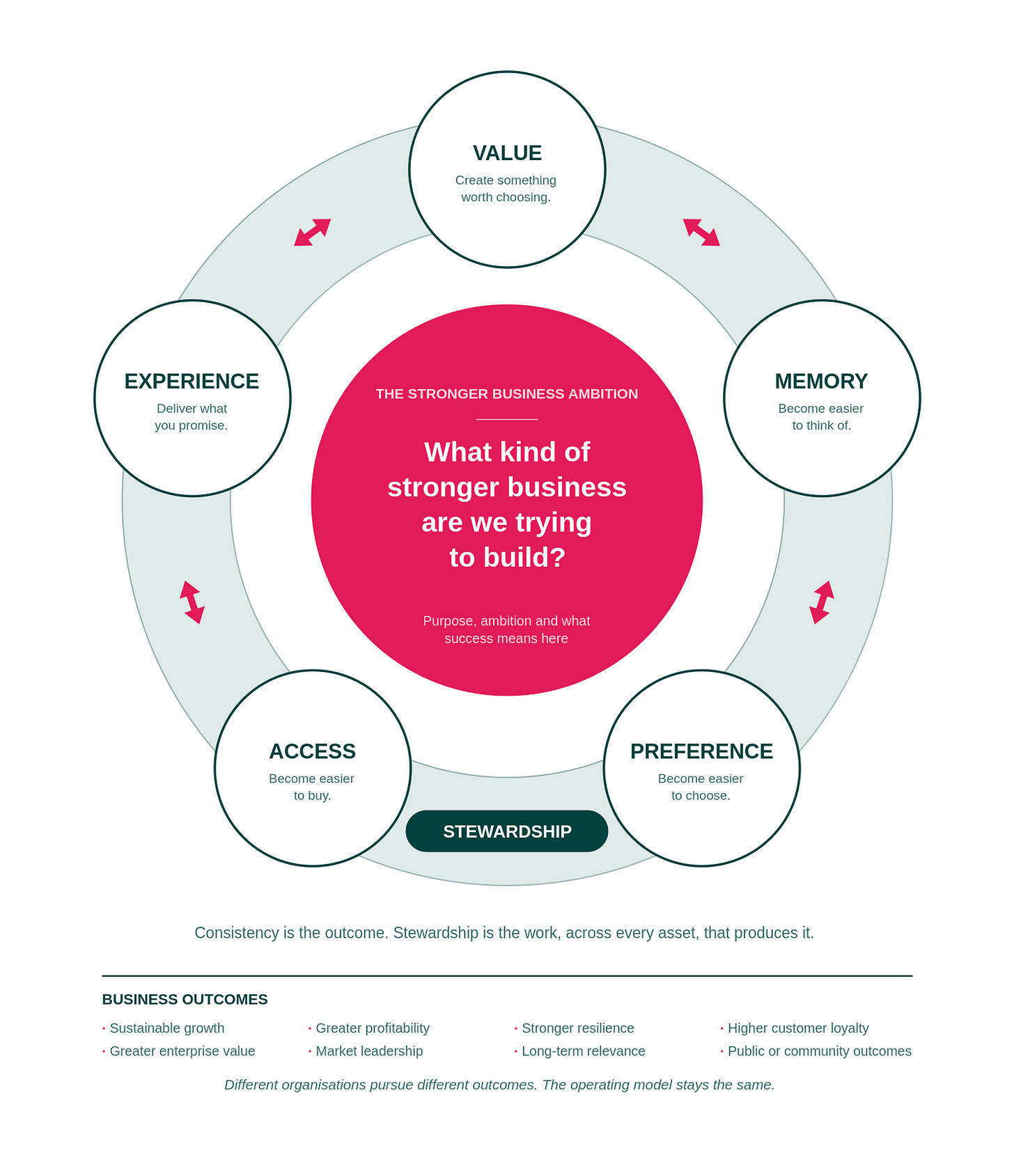
This is one part of the Stronger Business Operating Model, which I have written up in full here: https://somethingdifferent.co.nz/musings/the-stronger-business-operating-model.html.
The key takeaway is the second question, because it is the one nobody asks. Where is your business already strong, and what is stopping you from being paid for it?